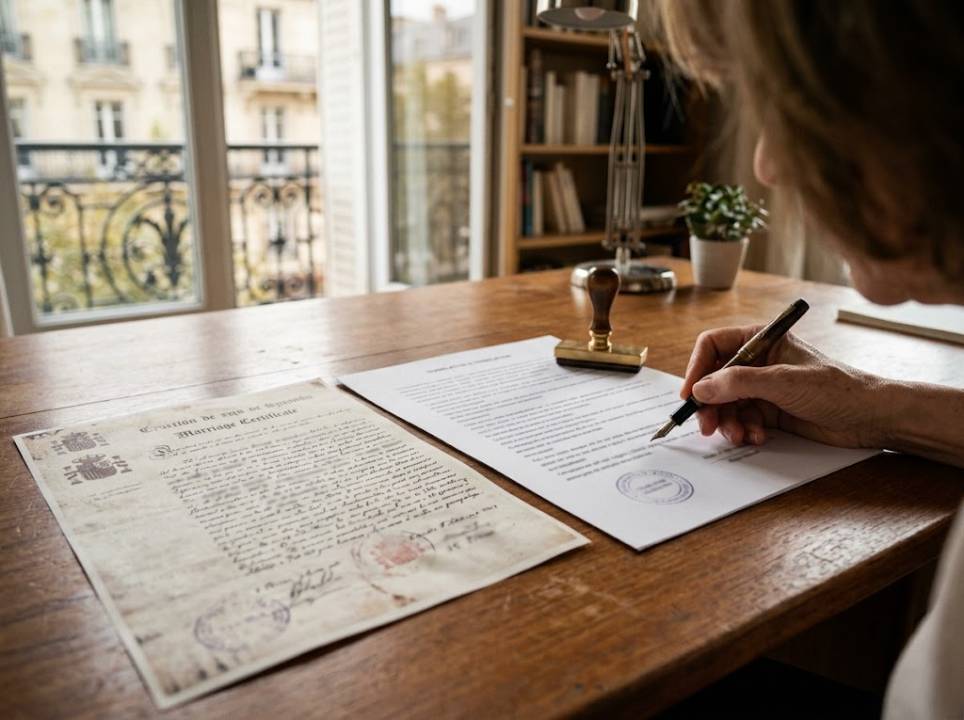
Every week, immigration offices, universities and courts reject documents not because the original is wrong, but because the translation does not meet the rules. A birth certificate from Guadalajara, a marriage record from Madrid or a diploma from Bogotá can stall an entire application if the English version lacks one line of certification.
The confusing part is that "certified translation" means slightly different things in different countries. Knowing what the receiving authority expects is the single best way to avoid delays.
What a certified translation is
In general terms, a certified translation is a complete and accurate translation accompanied by a signed statement from the translator or translation company. That statement confirms that the translation is true to the original and that the translator is competent in both languages. It usually includes the translator's name, contact details, signature and the date.
It is not the same as a notarised translation, where a notary verifies the identity of the person signing, nor a sworn translation, which in many European countries is done by a translator officially appointed by a court.
The United States approach
In the United States, there is no federal licence for translators. Instead, agencies set their own requirements. The best known is U.S. Citizenship and Immigration Services, which requires that any foreign-language document submitted with an application be accompanied by a full English translation. The translator must certify that the translation is complete and accurate and that they are competent to translate from the foreign language into English.
Key points for USCIS submissions:
- The translation must cover the entire document, including stamps, seals and handwritten notes.
- Summaries or extracts are not accepted.
- The applicant cannot certify their own translation.
- Notarisation is generally not required, though some other agencies ask for it.
Spanish is by far the most common source language for these documents in the US, which is why English to Spanish and Spanish to English certified translation has become a specialised field of its own.
The United Kingdom approach
The UK follows similar principles but with its own expectations. The Home Office requires that translations of documents supporting visa and citizenship applications be certified by the translator or translation company. The certification must confirm that it is an accurate translation of the original, give the date, the translator's full name and signature, and provide contact details.
Many applicants choose professional certified translation services uk providers precisely because the Home Office can contact the translator to verify the work. Since 2022, Ukrainian families arriving under UK visa schemes have relied heavily on this kind of service for birth, marriage and education records.
Common reasons for rejection
Translations are usually rejected for avoidable reasons:
- Missing certification statement or signature.
- Names spelled differently from the passport.
- Untranslated stamps, margin notes or seals.
- Dates converted incorrectly, especially between day-month and month-day formats.
- Translations done by family members or the applicant.
Date formats deserve special attention. A Spanish or Latin American document reading 04/07/1990 means 4 July. A careless translation into US format can turn it into 7 April, creating an apparent mismatch with other records.
Beyond Spanish
Spanish dominates certified translation requests in the US, but many other languages are common. Applicants from Russia, Kazakhstan, Belarus and other Russian-speaking countries often need birth certificates, police clearances and diplomas translated. Professional russian translation services familiar with Cyrillic transliteration standards help keep names consistent with passports.
French is another frequent language, both from France and from francophone Africa, Haiti and Canada. Students applying to US or UK universities, and families applying for visas, regularly need certified french translation services for transcripts, civil records and court judgments.
Choosing a provider
When selecting a translator or agency for certified work, check that they:
- provide a signed certification on letterhead with full contact details;
- translate every element of the document, including stamps and annotations;
- follow the spelling of names exactly as it appears in your passport;
- know the specific requirements of the authority you are submitting to;
- offer secure handling of personal data.
Membership in professional bodies such as the American Translators Association or the UK's Institute of Translation and Interpreting can be a useful signal of quality, although it is not always required.
When official documents must be accepted abroad, working with professional translation services ensures the certification meets the receiving authority's standards. A reputable provider understands USCIS and Home Office requirements, from signed statements to complete translations of stamps and seals. The translator should be reachable for verification if questions arise during processing. Getting the certification right the first time prevents costly delays.
Digital submissions
More and more applications are now submitted online. That usually means uploading a scan of the original and a PDF of the certified translation. Make sure the scans are clear, in colour where stamps are coloured, and that each page of the translation is legible and includes page numbers. Some authorities still ask for originals later, so keep the paper versions safe.
The bottom line
A certified translation is a small part of a big application, but it can decide whether that application moves forward or sits in a pile awaiting more evidence. Getting it right the first time saves weeks, sometimes months, of waiting. Whether your documents are in Spanish, Russian, French or any other language, the same rules apply: complete, accurate, consistent and properly certified.